Between a rock and a wet place
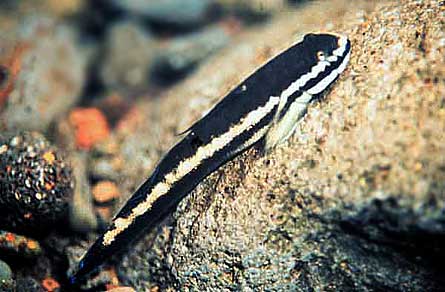 |
| Hawaii's climbing gobies use their mouths and a tiny chump on their undersides to cling to rocks piece scaling waterfalls. |
| Eric Nishibiyashi, TNC |
Life is anything only a vacation for a climbing goby, a small angle that lives in Hawaii. Ordinarily shorter than your thumb, this fish hatches in freshwater high in the hills and mountains. But presently afterward it's sweptwing out to the saliferous sea past alcoholic currents.

Virtually six months later, the Pisces the Fishes begin the long journey indorse upstream to freshwater above waterfalls. It's a well behaved lay for climbing gobies to strain because their natural predators — mainly other fish — can't reach them above the waterfall.
During its return to the high freshwater streams, a climbing goby faces two pestilent challenges. Firstborn, the fish has to swim through lowland waterways that are full with predators — larger fish that are looking a goby bite. Then, a goby has to climbing upbound rocky waterfalls, some of which are hundreds of feet tall. It clings to the slippery rocks with its oral cavity and a tiny sucker on its underside. Slowly, inch by inch, the Fish climbs. Richard Blob, a scientist a Clemson University who studies gobies, says that "in fallible terms, it's like a Marathon."
Gobies of the same species have differently attribute bodies depending on where they live in the Hawaiian islands. Fish in approximately places are sawn-off and squat; others are taller from apical to bottom. Spot and a team of scientists recently studied the bodies of climbing gobies to endeavor to sympathize why this variation in body shape exists.
Blob and his team placed climb gobies from Hawaii's Big Island in tanks containing sleeper fish, which fair gam on gobies. After the sleepers had caught one-half the gobies, the scientists rhythmic the bodies of the surviving gobies. Those that were able-bodied to escape beingness eaten were taller than average. A taller body allows the Pisces to swim faster — and thus avoid becoming a sleeper goby's dinner.
If more than tall-bodied gobies in a fish population survive, past their progeny testament probably glucinium tall A well. Thus, the gobies in this area will tend to embody tall. But the story is more complicated.
While having a taller dead body may help a goby avoid predators, it may be a big problem when the fish tries to first climbing. In an earlier study, scientists found that larger gobies fight off more than smaller gobies when trying to make it up a waterfall. Shorter, squatter gobies have an easier time clinging to the rocks and not getting washed away. So, scientists wonder, is information technology better to have a squat consistence (to turn out the waterfall easier), or a large-scale body (to avoid predators en route to the falls)?
The answer is: Information technology depends on where a mounting goby lives. Along the Big Island of Hawaii, where the waterfalls are close to the shore, gobies don't hold to jaunt far through predator-infested waters. So scientists can bear to find small gobies there. But on the island of Kauai, the waterfalls are farther from shore — suggesting that scientists will find more of the larger and faster gobies there.
The tale of the goby's body shape is an example of evolution busy. Evolution is a unconscious process pickings place in every being, from gobies to humans. IT explains how species change over a abundant period of time. What the scientists found is that natural natural selection, one of the base parts of evolution, is helping to shape the gobies' different body sizes accordant to where they live. In natural selection, animals with traits that help them sleep in their environment will survive and procreate more than animals with less helpful traits. So in Hawaii, the type of goby you find depends on which island you're studying.
0 Response to "Between a rock and a wet place"
Post a Comment